Using Talent Dense Hiring Channels
Hiring is chess meets private investigation. Can you find the pockets of the internet no one else knows about?
TL;DR
The Core Insight: Every company is recruiting from the same pool of candidates on LinkedIn. I call these pockets of the internet "ponds," and our goal is to become experts at open source investigation where we find ponds that have high talent density and low competition.
Focus on These 3 Things:
- The Pond Map: GitHub contributors, Discord servers, conference speakers. Where do YOUR candidates actually hang out?
- Familiar But Surprising: Emails that pass the "WTF how did this person know this about me" test. The goal is 80% response rate on the first outreach.
- Multi-Channel Stack: Email + DM within 15 minutes increases your odds even further
The Core Philosophy
- Define the ideal candidate profile: The team decides who would be perfect for this role, whether they're available or not. We base the search around that profile to find similar profiles.
- Find hidden ponds where no other recruiters are fishing
- Map their online presence: Twitter, Substack, Discord, GitHub, courses
- Familiar But Surprising outreach: Emails that feel like a close friend wrote them while being professional. They pass the "WTF how did this person know this about me" test
- Build referral networks with hyper-connected sources for warm intros
The Pond Concept
A "pond" is a high-density location where your ideal candidates congregate.
| The Best Ponds Are | Why |
|---|---|
| Hidden | Not indexed by LinkedIn or job boards |
| High-density | Full of your target profile |
| Low-competition | Other recruiters don't know about them |
Why Not Just Use LinkedIn and ATS?
There are obvious places to look that I won't discount. Using Gem or Ashby (any ATS that includes candidate profiles) is not bad. It is just low probability because of the sheer amount of competition.
When you meet people in a different place where they hang out, add useful contributions to that group without being desperate to get them on a call... you lose the recruiter frame that everyone hates in tech and build relationships with future hires.
Where Ponds Live
| Platform Type | Examples |
|---|---|
| Communities | Discord servers, Slack channels, SKOOL groups |
| Content | Newsletters, podcasts, YouTube channels |
| Events | Conferences, meetups, professional associations |
| Networks | Referral chains, alumni groups, masterminds |
| Open Source | GitHub repos, HuggingFace, Papers with Code |
The Ideal Candidate Profile
Start with a real person, not a job description.
The team sits down and answers one question: "If we could get anyone in the world for this role, who would it be?" This person might already be employed. They might not even be looking. That does not matter.
Why this works:
- You now have a real human being to study
- You can find where they hang out online
- You can find who they follow and who follows them
- You can find similar profiles to theirs
The process:
| Step | What You Do |
|---|---|
| 1. Name the dream candidate | Team agrees on 1-3 people who would be perfect |
| 2. Map their digital footprint | Twitter, GitHub, Substack, podcasts, conferences |
| 3. Study their network | Who do they follow? Who engages with their content? |
| 4. Find the ponds | Where do people like them congregate? |
| 5. Search for similar profiles | Same background, same interests, same skills |
The "Hidden Gem" Signal
Once you know your ideal profile, look for candidates with these signals:
| Signal | Why It's Good |
|---|---|
| Proven competence online (blog, portfolio, GitHub) | They can do the work |
| Semi-active on Twitter/LinkedIn | They're reachable |
| No longer posts frequently on blog/Substack | They're not making FT income from content |
| Working FT at company + writing on side | They have the skill but need the opportunity |
Why they're gems: A job offer may be a dream come true due to:
| Reason | What It Means |
|---|---|
| Money | Stable income for their craft |
| Elevated status | Work with industry leaders |
| Opportunity | Access they couldn't get alone |
The Research Process
Before you source, research:
- Who is our ideal candidate?
- Where do they hang out online?
- Who do they follow and trust?
- What communities are they part of?
This research ends up in your Pond Map.
The 5-Part Research Framework
Part 1: Map Your Ideal Candidate's World
Once you have your ideal candidate profile (see Step 1), answer these questions about them:
| Question | Why It Matters |
|---|---|
| Who does this person follow on Twitter/LinkedIn? | Follow the influencers to find the followers |
| Where do they hang out online? | Identifies ponds |
| What communities are they part of? | More ponds |
| Who are the hyper-connected people in their world? | Referral sources |
| Who is the most famous person in their niche? | Track their audience for similar profiles |
Part 2: Gather Real World Feedback
During the pond search, you are gathering data that helps the entire process. Real world feedback you can use.
Example: The ML Hiring Disconnect
This Reddit post from a founder hiring ML engineers captures exactly what we are looking for:
What candidates tell me they know:
- Transformer architectures, attention mechanisms, backprop derivations
- Papers they've implemented (diffusion models, GANs, latest LLM techniques)
- Kaggle competitions, theoretical deep learning, gradient descent from scratch
What we need them to do:
- Deploy a model behind an API that doesn't fall over
- Write a data pipeline that processes user data reliably
- Debug why the model is slow/expensive in production
- Build evals to know if the model is actually working
- Integrate ML into a real product that non-technical users touch
The gap: Courses teach you to build models. Jobs need you to ship products that happen to use models.
This is a non-negotiable filter. We are not looking for people who can explain LoRA fine-tuning in detail but have never deployed anything beyond a Jupyter notebook.
Part 3: Learn How to Talk to This Role
Calibrate your language. Pick up on what gets candidates excited and use that for how you sell the role.
| Question | Purpose |
|---|---|
| Has anyone written about hiring this role? | Learn from others |
| Who has already solved this that I can learn from? | 80/20 research |
| Can I brain dump everything I know about this role? | Surface gaps |
Part 4: Find the Ponds (Community Discovery)
| Platform | Where to Look |
|---|---|
| SKOOL | Paid communities for professionals |
| Discord | Technical communities, open source projects |
| LinkedIn Groups | Professional associations |
| Facebook Groups | Industry-specific groups |
| Slack Channels | Company alumni, interest groups |
| Courses | Who takes courses in this skill? |
| Newsletters | Who reads newsletters about this? |
Part 5: Define the Filter
The Knock-Out Question: A single question that immediately determines fit.
The 3 MUST HAVEs: What must appear on their profile/resume to be considered?
- [Must have #1]
- [Must have #2]
- [Must have #3]
Leaving LinkedIn & Advanced Search Techniques
Why leave LinkedIn? ⅓ to ½ of LinkedIn profiles are invisible because people are set to private. You're missing half the talent pool.
Search Modifiers (Critical to Understand)
| Modifier | What It Does | Example |
|---|---|---|
"quotes" | Exact phrase match | "machine learning engineer" |
() | Groups terms together | (speech OR audio OR ASR) |
OR | Either term or both | whisper OR "speech recognition" |
* | Wildcard placeholder | "ML * engineer" finds ML Research Engineer |
AND | Both terms required | "on-device" AND inference |
NOT or - | Excludes term | "ML engineer" -recruiter -jobs |
Global Field Search Commands
| Command | What It Does | Why It Matters for Recruiting |
|---|---|---|
intitle: | Results with term in page title | Find pages explicitly about resumes or CVs (intitle:resume) |
inurl: | Results with term in URL | Find portfolio pages (inurl:portfolio) or about pages (inurl:about) |
site: | Results from specific website | Search only GitHub (site:github.com) or only .edu domains (site:*.edu) |
filetype: | Results of specific file type | Find actual resume PDFs floating on the web (filetype:pdf) |
Google Dorks That Actually Work (Copy-Paste Ready)
What is a Google dork? A search string that uses advanced operators to find specific information that normal searches miss. Hackers use them to find vulnerabilities. Recruiters use them to find candidates.
Test these yourself. These are optimized for ML engineers but the patterns work for any role.
Finding Resumes (filetype:pdf):
filetype:pdf "ML engineer" "speech recognition" resume
filetype:pdf "ML engineer" "inference" site:*.edu
Finding Profiles (intitle:):
intitle:resume "machine learning" "speech" -jobs
intitle:CV "ML engineer" "production" "Python"
Finding People Who've Written About Their Work:
intitle:"about me" "on-device ML" -jobs
Finding GitHub Profiles:
site:github.com "ML" "speech recognition" -jobs
Finding Personal Sites:
"ML engineer" "I build" "inference" -linkedin -indeed
The Pendulum Method
- Cast a wide net first
- Narrow through experimentation
- Start with just 2 keywords
- Vary choice of keywords until specific
The Future: AI Recruiting Agent
These Google dorks work but they're manual. The real leverage is building an agent powered by Opus 4.5 (or any frontier model) combined with Exa.ai that runs these searches automatically.
The Vision: A full recruiting agent could run all these searches with a high quality knowledge base, work WITH the recruiters, find people very quickly, return ranked and deduplicated results, and alert you when new profiles match your criteria.
Finding Hidden Ponds (Telegrams & Discords)
One way to find hidden ponds is to use Programmable Search Engines (PSEs). These are custom Google searches that other smart people have already built, and we can stand on their shoulders.
What are PSEs?
PSEs are search engines you can create yourself based on certain parameters which specializes your searches using Google. But luckily for us, other people have already done the hard work and made their PSEs public.
Example: Finding ML Telegram Groups
- Go to xtea.io/ts_en.html
- Search something basic like "machine learning"
- Now it pulls up every ML Telegram group you could join
This is how you find ponds that no other recruiter knows about.
Example: The Private Investigator Method
Found this repo: harvard-edge/cs249r_book
At first glance, it's not exactly what we want. It's a beginner's guide to building ML models from scratch.
But scroll to the bottom and look at the contributors. Study their GitHub profiles. See where else they've contributed. Now you're being a private investigator, and that leads you into incredible ponds of hidden talent.
The repo itself is not the pond. The contributors are the pond.
When studying a profile, ask yourself: Who do these people know? What motivates them? What keeps them up at night?
Example: YouTube Sponsors as a Pond
Another way to quickly find ponds: YouTube videos that teach people how to build ML models. Take this beginner's guide to TinyML. It's a beginner's video, but go deeper. Look at who supported this video: davthecoder, jedi-or-sith, Agustín Kussrow, Serhiy Kalinets, Oscar Rahnama.
Now find who these people are. Find their GitHub profiles. Find their X profiles. See if they match the ideal candidate you're basing your search around. People who pay to support ML education content are often ML practitioners themselves.
OSINT Resources:
| Resource | What It Does |
|---|---|
| Dean Da Costa's StartMe Page | Every OSINT tool a recruiter would ever need |
| OSINT Framework | Visual map of OSINT tools organized by category |
| Discord & Telegram OSINT References | GitHub repo for finding Discord/Telegram groups (some links expired) |
| xtea.io Telegram PSE | Search engine specifically for Telegram groups |
The "Secret Note" Template
The Goal: Get them to respond to your FIRST message using everything you collected in your research. Any follow ups rely heavily on what you say in your first outreach. Keep it simple.
The Core Formula: Familiar But Surprising
Familiar: Reference something they know (their work, their content, mutual connection) Surprising: Say something unexpected that makes them stop and think "wait, who is this?"
This framework is what I found gets people to respond at 60-80% off the first email. Film directors discovered this many years ago. People love sequels because people love nostalgia. The best sequels bring you back into your favorite childhood film, but add a surprising twist.
You want to pass the "WTF" test. If you walked up to this person cold, what single line could you say that would get them to stop, think you're their friend, and want to know who you are? It shows you've researched them and you care.
How to know you found something unique: If a random person read the entire email, they wouldn't understand everything because it's so specific to that person. You don't always have to follow this, but that's a great indicator.
Part 1: The Subject Line
The Goal: Get the open so they read the first line of your message.
The Rule: Don't overcomplicate. Add a familiar but surprising twist in the subject line.
| Template | Example |
|---|---|
| Your [Podcast/Tweet/Blog Post] on [Specific, Obscure Topic] | "Your podcast on 'hiring headaches' (i can help)" |
| hey [name], I'm your next [role] | "hey Tanay, I'm your next recruiting lead" |
| 2 ways I can solve your [biggest headache] at [company] | "2 ways I can solve your ML hiring bottleneck at Wispr" |
Don't clickbait. If you write a subject line like "referral from [important person] for your [open role]" you better defend that in the first line. Keep it straight, clean, and simple.
Part 2: The Email Body (4-Step Protocol)
Step 1: The Familiar But Surprising Hook
The Goal: The first 10 words must pass the "WTF, how do you know that?" test.
Hey [First Name],

[Your single, best "Familiar But Surprising" hook goes here.
You will have many from your research. The key is to pick
one you can tie back into your own life without lying.
Something a friend would know and point out.]
Examples of hooks that worked for me:
"Hey Mark, Your blog + story inspired me to reach out... Phase 1 (growing up poor) -> Phase 4 = incredible." (Written to a famous writer about his life phases framework)
"Hey Jeremy, I've been copying your tweets by hand as a weird morning ritual." (Written to a founder/investor known for his Twitter threads)
Step 2: Connect Their World to Yours
The Goal: Be human. Don't be weird. Yes, you are going to pitch them to look at your application, but make this seamless.
That one thing you said about [Their Philosophy] really hit me
because [Your Genuine, Personal Connection to that Idea].
Example that worked for me:
"'You don't only live once' is an idea I often come back to because of you. Thank you." (Written to a productivity writer about her philosophy on life)
Step 3: The High Value Offer
The Goal: The big reveal of your application that positions you as the product that will solve their pain point.
One of your biggest headaches right now is [The Specific Pain Point]
which you said [where you found headache] and [second place you found it].

I spent the last 7 days building a custom project that solves [pain point].
I think this could help (would love to become your new [role]).

You can see it here: [Link to Your Project]
[How long it will take them to review it]
Example that worked for me:
"My application will prove that I am willing to go above and beyond... mattloveskirby.com/hirematt... Please take a look (guaranteed to make you smile in the next 3 mins)." (Written to a YouTuber I wanted to work for)
Step 4: The Confident Close
The Goal: End with high status. You know your project was great. You're not desperate.
Let me know what you thought of the project! I had fun making it
and will use [product] regardless of what happens next.

Talk soon,
[Your Name]
The Powerful PS
This is the second most read part of any email.
Typically someone reads: Subject line → First line → PS. We use the PS to clear skepticism and get them to go back and read the full message.
| PS Option | When to Use It |
|---|---|
| Quick 5-15 second video saying hello | Puts a face to the name, gets them to read the message |
| Go deeper into your background | When your story connects to theirs |
| Final piece of "Familiar But Surprising" proof | One more detail that shows you did your research |
PS: [Add one final, human, and slightly playful touch.
A link to a 15-second video, a witty comment,
a final piece of "Familiar But Surprising" proof.]
Examples that worked for me:
"PS: 15 second video putting my face to the name" (Quick video builds trust faster than any written word)
"PS: When people tell others to be authentic... they're really asking them to speak the way they would to their best friend. This was a major unlock for me because of your post..." (One more familiar but surprising hook to clear any remaining skepticism)
Make Sure They See Your Message (Stacking)
Stacking: Write your outreach on as many platforms as you can reach your target person on. Send the email first, then find their Twitter, rewrite it slightly for that platform, and mention that you emailed them. You raise your odds of them responding on the first reach out this way.
Pick two or three of these at once and keep doubling down on the free ones until you get a response:
| Channel | Notes |
|---|---|
| Cold email | Primary channel |
| Twitter DM | High response for tech/creator types |
| Instagram DM | Good for certain industries |
| Their Discord | If they have a community |
| Their personal community | Buy access if not expensive |
| intro.co | Pay for a legitimate intro |
| Venmo $10 | With a message to check your email |
| Handwritten note | Gets them to open your email |
| Usually lower priority but still valid |
90% of the time, email + Twitter will work. But sometimes creative measures are needed. If you go through ALL of these and still don't get through, revisit your outreach and adjust it.
Full Template (Copy-Paste Ready)
Write this in a doc or note on your phone. Make sure when you copy and paste it into your email or DM that the message is formatted properly before you hit send.
Subject: Your [Podcast/Tweet/Blog Post] on [Specific Topic]

Hey [First Name],

[Your single, best "Familiar But Surprising" hook here.]

That one thing you said about [Their Philosophy] really hit me
because [Your Genuine, Personal Connection to that Idea].

One of your biggest headaches right now is [Pain Point]
which you said [where you found it] and [second place you found it].

I spent the last 7 days building a custom project that solves [pain point].
I think this could help (would love to become your new [role]).

You can see it here: [Link to Your Project]
[How long it will take them to review it]

Let me know what you thought of the project! I had fun making it
and will use [product] regardless of what happens next.

Talk soon,
[Your Name]

PS: [One final, human, playful touch. Video link, witty comment,
or final piece of proof.]
The Referral SOP
Best candidates come from warm intros, not cold outreach.
Become the Founder's Right Hand
One powerful technique: become the personal right hand recruiter to the founders.
This is what I did at Flow Research Collective when I was Head of Talent. I had access to the CEO's LinkedIn. I could send emails from his email to incredible people. I used his status as leverage to speak to great people.
Not every call I set up was about "I want to hire you." Some calls were for him to build a connection that could turn into fundraising or warm intros to other great people.
Why this works:
| Benefit | What It Does |
|---|---|
| Founder's status opens doors | People respond to founders who wouldn't respond to recruiters |
| Builds the network, not just the pipeline | Connections become investors, advisors, referral sources |
| Removes the recruiter frame | You're setting up a conversation, not a sales pitch |
Mine Existing Founder Conversations
So who has Tanay and Sahaj, and the rest of the Wispr Flow team talked to already? Is there a consistent way they are tracking conversations outside of just Wispr Flow hiring convos?
These are all warmer conversations that can lead us to finding incredible people.
The Daily Practice:
Imagine we hit up 3 world class human beings every day with familiar but surprising emails. We keep conversations fresh. We reach out to add value. In the hope that the universe reciprocates our efforts to aid our quest to reach Act 3 and help billions of people communicate freely using Wispr Flow.
Build Your Referral Shortlist
- Maintain a list of 20 people who can refer great talent for each role
- Each person helping with hiring contributes to this list
- Incentivize with $$ if referral stays 90 days
- Run through this list monthly
- Mine their networks: go through their LI/Twitter connections
The Key Principle: Do the Work for Them
Don't ask: "Do you know anyone?"
| Instead | Do This |
|---|---|
| Look at their connections | Mine their LI/Twitter for potential fits |
| Identify 3-5 people | Who might match your target profile |
| Make a specific ask | "Would you be willing to forward this email to [Name]?" |
Example: Reaching Hard-to-Reach People
When direct outreach fails, go through their network:
Hi [Name] - I've been hand copying impactful sections from your podcast,
blogs, tweets, and book as an idea sex ritual.

Whatever I want to ingrain into my brain as if I was you, I handwrite it.
Your ability to simplify complexity as if I was 8 years old is a skill
I'd like to master one day.

Thank you for teaching me to be the ONLY, never better!

My wife would say that I've consumed your podcast too much. I say that's BS.
Knowledge monetizes forever.

I specifically enjoyed the chat you had with [Target Person], how to make
a few Billion Dollars.

You've put him on my radar. I've since emailed him three times to set up
a podcast/meeting with my CEO, [CEO Name].

We run a research & training company that teaches executives how to work
optimally through our research into flow states.

I value your time. I included my initial three emails to [Target] below.

Would you have the bandwidth to forward this email to [Target]'s
representative (whoever helps him book podcasts)?

Thank you,
[Your Name]

PS - The second link to subscribe to your newsletter does not work: [link]

PPS - Bob Ross is the GOAT
Why this works:
| Element | Purpose |
|---|---|
| Lead with genuine appreciation | Not fake flattery |
| Show you've consumed their content | Proves you're not mass blasting |
| Reference specific content | Something only a real fan would know |
| Explain why you're reaching out | Clear ask, clear context |
| Do the work for them | Include the emails to forward |
| Make the ask easy | "Just forward this" |
| PS adds personality | Plus provides value (broken link) |
Tracking TA Generating Activities
The 3 Metrics That Matter
| Metric | What It Measures | Why It Matters |
|---|---|---|
| % of interviews pond generates | Quality of source | LinkedIn: 1000 leads → 5 interviews. Headhunting: 20 leads → 5 interviews. Second source = 50x better. |
| Interviews per offer | Candidate quality | Lower = higher quality entering funnel |
| Hiring manager accept rate | Recruiter calibration | Goal: 70%+ of submitted candidates get HM call |
The 4-Phase Sourcing Timeline
| Phase | Days | Focus |
|---|---|---|
| Phase I | Day 1 | Active seeking: inbox, ATS, premium sources |
| Phase II | Day 2-3 | Open web: resumes, social networks, communities |
| Phase III | Day 4-5 | Data mining: referrals, associations, alumni |
| Phase IV | Day 6+ | Deep web: patents, mailing lists, competitor mining |
12 Channels to Exhaust (In Order)
- Job postings & job board resumes
- Resumes from search engines
- Resumes from ATS (past applicants)
- Recruitment marketing
- Deep web research (direct sourcing)
- Conferences, professional associations
- University & Corporate Alumni Orgs
- Specialized leads databases
- Diversity communities
- Online communities (Discord, SKOOL, Slack)
- Online social networks (LI, FB, Twitter)
- Other social media (blogs, personal sites)
Previous Applicant Mining
One applicant = multiple leads
- Who applied to this role before?
- What company did they work at?
- Can we reach out to THEM for referrals?
- Can we look up their company and find others with this title?
Wispr Flow Application: ML Engineer Target Profile
Where to find the top 0.1% of inference optimization engineers.
Must-Haves (Technical)
| Requirement | Why |
|---|---|
| Deep inference optimization experience | Latency, not just accuracy |
| C++ proficiency | On-device work requires it |
| Quantization, pruning, distillation | Core compression techniques |
| Shipped production ML systems | Not just research |
Nice-to-Haves
| Skill | Context |
|---|---|
| On-device/mobile ML | iOS, Android, edge devices |
| Audio/speech processing | Domain expertise |
| Real-time systems | <200ms latency requirements |
| Open-source contributions | Proof of work |
Culture Fit Signals
| Signal | What It Means |
|---|---|
| Uses Linear, not Jira | Or actively hates Jira |
| Has shipped something themselves | Not just "contributed to" |
| Left Big Tech for ownership | Impact-driven |
| Already uses Wispr Flow | Or similar tools |
| Wants to build, not just optimize | Builder mentality |
Anti-Signals
| Red Flag | Why |
|---|---|
| "What's the career ladder?" | Wrong motivation |
| Empty GitHub | Claims to love coding but no proof |
| Work-life balance over mission | Not startup mindset |
| Needs extensive process/docs | Can't operate autonomously |
| Title-focused | "I want to be a Staff Engineer" |
How to Evaluate: Proof of Work Signals
GitHub Profile
| Green Flags | Red Flags |
|---|---|
| Repos with actual READMEs and documentation | Only Jupyter notebooks with no structure |
| Clean, maintainable code | Repos that are just course assignments |
| Contributions to production ML repos | No commits in 2+ years |
| MLOps artifacts: Docker, CI/CD, deployment configs | Only forked repos, nothing original |
| Recent activity (still coding, not managing) |
High-signal repos to check for contributions:
| Repo | What It Shows |
|---|---|
openai/whisper | Speech recognition expertise |
huggingface/transformers | NLP/model expertise |
ggerganov/whisper.cpp | On-device optimization |
pytorch/pytorch | Deep framework knowledge |
NVIDIA/TensorRT | Inference optimization |
mlflow, wandb | MLOps maturity |
Technical Writing / Blog Posts
| Green Flags | Red Flags |
|---|---|
| "How we reduced inference latency by 50%" | Only "intro to ML" tutorial content |
| "Lessons from deploying ML at scale" | All theory, no production experience |
| Detailed technical deep-dives with code |
Papers / Publications
| For Wispr, Look For Papers On |
|---|
| Speech recognition / ASR |
| Model compression / quantization |
| On-device ML |
| Real-time inference |
Green flag: Paper that shipped to production Red flag: Only theoretical papers with no real-world application
Wispr Flow Application: ML Engineer Sourcing Tiers
The best ML engineers aren't on LinkedIn. They're in GitHub repos, Discord servers, and academic labs.
Tier 1: High Signal (Engineer-Driven Communities)
| Source | How to Find Candidates |
|---|---|
| GitHub Trending | Engineers whose code is used by others. Check Whisper repo contributors. |
| Hugging Face | Model creators, especially speech/audio models. Active in discussions. |
| ArXiv / Papers With Code | Researchers publishing on speech recognition, model optimization, on-device ML. |
| Twitter/X ML Community | Engineers tweeting about Whisper, speech ML, on-device AI. |
| Discord | Hugging Face, MLOps Community, EleutherAI servers. |
Best pond: Check Whisper GitHub contributors. They've already solved half of Wispr's problems.
Tier 2: Strong Signal (Domain Specific)
Conferences:
| Conference | Focus |
|---|---|
| NeurIPS | Top ML research |
| ICML | Machine learning |
| Interspeech | Speech/audio specific (GOLD for Wispr) |
| ICASSP | Audio/speech processing |
Company Alumni (who've solved similar problems):
| Company | What They Know |
|---|---|
| Deepgram | Production speech ML |
| AssemblyAI | Real-time transcription |
| Rev / Otter.ai | Consumer voice products |
| OpenAI (Whisper team) | Foundation of modern speech ML |
| Amazon (Alexa) | On-device + cloud hybrid |
| Apple (Siri) | On-device privacy |
| Google (Assistant) | Scale + accuracy |
| Nvidia (NeMo) | Inference optimization |
| Meta (speech) | Speech research at scale |
| Microsoft (Nuance) | Medical/legal accuracy |
The Crunchbase Strategy
Use Crunchbase to find every later stage AI company (we are still so early in this space).
The process:
- Search for AI/ML companies by funding stage (Series A+)
- Map the ML engineers at those companies
- Research what each company is solving
- Note how long people have been there
- Create a giant shortlist of candidates we would love to learn more about
Companies to watch for talent movement:
| Company Type | Why |
|---|---|
| Humane, Rabbit | Hardware AI pivoting |
| AI startups post-Series B | No clear product-market fit |
| Track LinkedIn job changes | From these companies |
Tier 3: Academic Ponds
PhD students and postdocs who want to build, not just publish.
| Institution | Lab/Program |
|---|---|
| MIT | CSAIL - Speech Group |
| Stanford | NLP Lab |
| CMU | Language Technologies Institute |
| Columbia | Speech Processing |
| UC Berkeley | BAIR |
Target: PhD students in years 4-6 (ready to leave), with industry internships
Tier 4: Community Ponds
| Community | Platform |
|---|---|
| Whisper GitHub Contributors | GitHub |
| TinyML Community | Discord/Twitter |
| ONNX Runtime Contributors | GitHub |
| llama.cpp Contributors | GitHub (focus on quantization) |
Pond Discovery in Action
This is the private investigator work. Here's exactly how to find hidden ML talent ponds for Wispr.
Finding Telegram & Discord Groups with PSEs
Use Programmable Search Engines (PSEs) that other smart people have already built:
- Go to xtea.io Telegram PSE
- Search "machine learning" or "speech recognition" or "on-device ML"
- Now you have a list of Telegram groups to join and lurk
More OSINT Resources: Discord & Telegram OSINT References (note: some links expired, but many still work)
The GitHub Contributor Method
Found this repo: harvard-edge/cs249r_book
At first glance, not what we want. It's a beginner's TinyML guide.
But scroll to the contributors. Study their GitHub profiles. See where else they've contributed. The repo itself is not the pond. The contributors are the pond.
When studying a profile, ask yourself:
| Question | Why It Matters |
|---|---|
| Who do these people know? | Network = more ponds |
| What motivates them? | Helps craft your pitch |
| What keeps them up at night? | Find the pain point |
High-signal repos to mine for contributors:
| Repo | Why It Matters for Wispr |
|---|---|
| openai/whisper | Core ASR technology |
| ggerganov/whisper.cpp | On-device optimization experts |
| huggingface/transformers | NLP/model expertise |
| NVIDIA/TensorRT | Inference optimization |
| tinygrad/tinygrad | Lean ML engineers |
The YouTube Sponsor Method
Find YouTube videos that teach TinyML or on-device ML. Example: Beginner's guide to TinyML
Look at who sponsored/supported the video: davthecoder, Agustín Kussrow, Serhiy Kalinets, Oscar Rahnama.
People who pay to support ML education content are often ML practitioners themselves. Find their GitHub profiles. Find their X profiles. See if they match our ideal candidate.
Telegram & Discord Groups to Join
| Group | Why |
|---|---|
| TinyML Foundation Discord | On-device ML community |
| Hugging Face Discord | Model builders |
| MLOps Community Slack | Production ML engineers |
| EleutherAI Discord | Open source ML researchers |
| Edge Impulse Discord | Embedded ML |
This Process Is Ongoing
All the ponds listed here are just the start. This is the bread and butter of what separates world class from average in hiring.
A recruiter must be deeply obsessed with finding pockets of the world wide web that nobody else is hanging out in.
Tools That Give Leverage
Exa.ai is basically a PSE on steroids. Build a recruiting agent with their API to automate pond discovery. This is exactly the kind of internal tool I would build to help myself and the rest of the team source.
How to Evaluate What Works
| Evaluate | By |
|---|---|
| Ponds | Talent density (how many candidates per hour of research?) |
| Tools | Leverage (how much time do they save?) |
| Channels | Response rate (are people responding?) |
Cut out anything that does not work. Document everything in our recruitment wiki for Wispr Flow to see.
Study the Greats
Recruiters must study the greats that come before them. Two incredible sourcers/recruiters that can help any recruiter level up 10x:
- Shally Steckerl - The godfather of sourcing
- Dean Da Costa - YouTube channel with sourcing tutorials
Dean's Public StartMe Page: Every OSINT tool a recruiter would ever need
The Underutilized Pond: Past Applicants
Another pond that's severely underutilized is the actual applicants who already applied and were rejected in the ATS (Ashby for Wispr Flow).
It seems obvious. Yeah no shit Matt. But the truth is that recruiters in tech don't really check applicants. It's headhunting first, applicants second.
Questions to ask:
| Question | Why It Matters |
|---|---|
| How many unread applications in the last 30 days? | Immediate opportunity |
| What about 12 months ago? | Candidates may have grown |
| Who did the team reject at the time? | Revisit with fresh eyes |
Why This Works
You can engage these candidates by searching through who already applied, what the team thought at the time (if rejected), and follow their progression. Maybe a candidate who was not a fit 12 months ago is a fit now. It is possible.
The Nurturing Campaign
You can create a nurturing sequence to candidates who applied in the past but did not make it to any technical screens.
Example: I once ran an email campaign to 10,000 applicants who were never looked at. The campaign told them: we're reaching out because they applied in the past, we're hiring now, and here's a short challenge to reengage with available roles.
You can filter these candidates based on role, make the challenge and application fun for them specifically, and warm up your entire past applicant pool this way.
Why This Method Works
| What 99% of Recruiters Do (Low Probability) | What This Method Does (Higher Probability) |
|---|---|
| Open LinkedIn Recruiter | Find a YouTube video about TinyML |
| Type keywords | Look at who sponsored it |
| Send InMails with "exciting opportunity" | Cross-reference their GitHub profiles |
| Wonder why response rates are 5% | Find the Discord they're active in |
| Blame the market | Study the community culture |
| Give up after 2 weeks | Show up with a profile that adds value |
| Repeat the cycle | Wait for them to DM you |
That's not recruiting. That's intelligence gathering.
You're treating sourcing like a PI would treat finding a person of interest. Follow the digital breadcrumbs. Map the connections. Understand the motivations. Build the relationship before making the ask.
How to Show Up in Ponds
Okay, you found the ponds. Now what?
You don't show up and immediately start recruiting. That's the fastest way to get banned and burn the pond forever.
Example: Showing up in a community pond
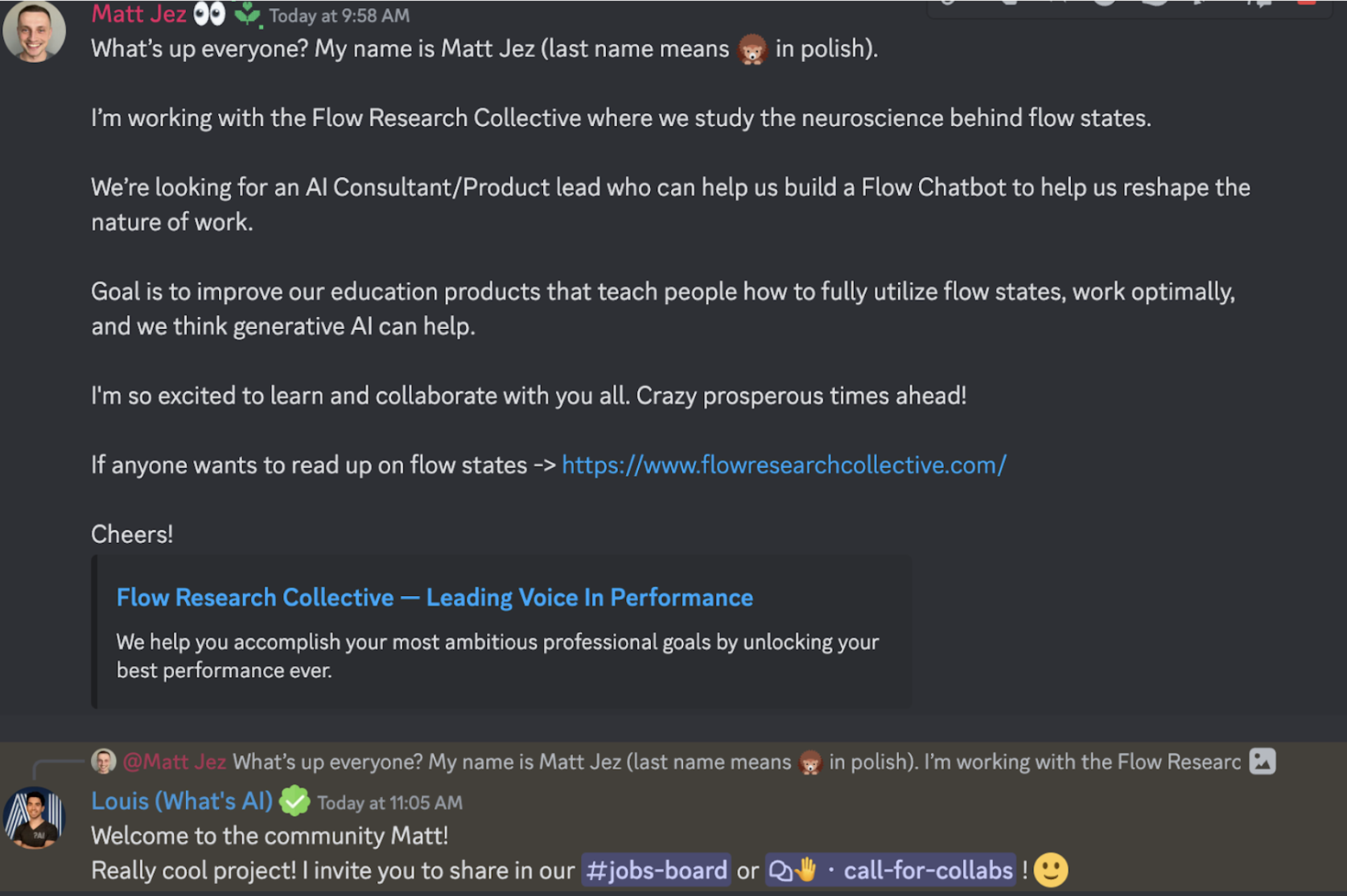
The Result: Hired an AI CEO consultant within 48 hours
We hired an incredible AI CEO to consult with us for 6 months as we were figuring out how to best integrate the tech into our product.
The path:
- Found his YouTube video
- Found his Discord from the video
- Saw he posted there
- DMed him on Twitter that I saw his YouTube video and comment in Discord
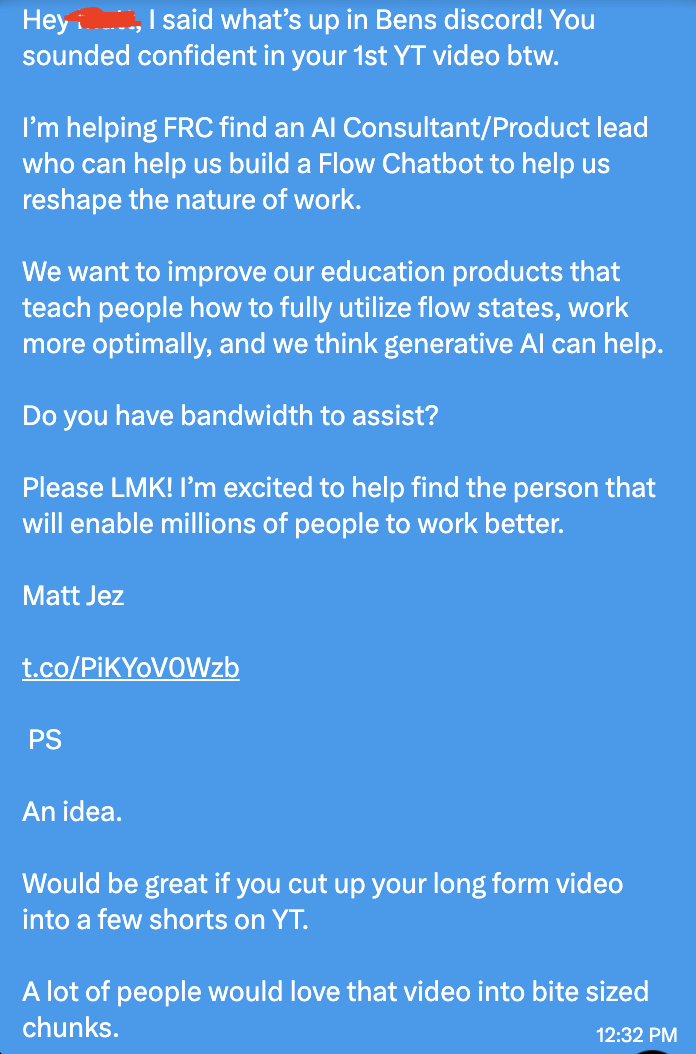
This is how pond discovery works in practice.
Example: How your profile should look when you join a community pond
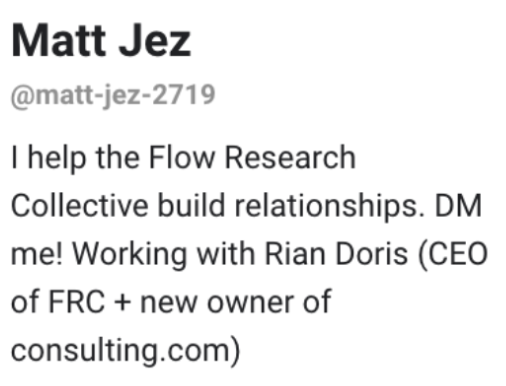
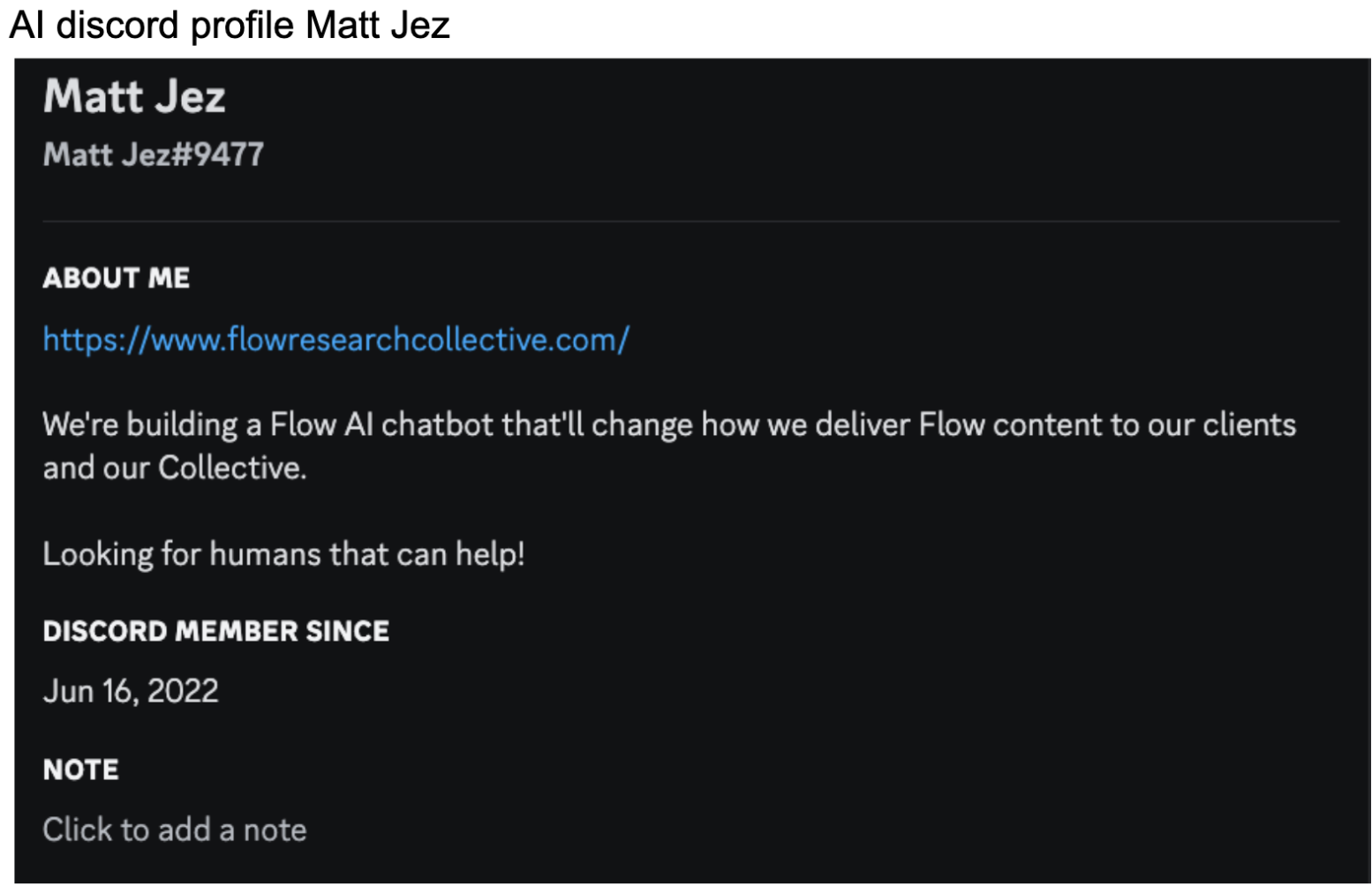
When you add value, people genuinely DM you instead of the other way around.
The Right Way to Enter a Community
| Do | Don't |
|---|---|
| Lurk first. Learn the culture. | Post a job listing on day one |
| Add genuine value before asking for anything | DM everyone with "great opportunity" |
| Answer questions you actually know the answer to | Pretend to be more technical than you are |
| Share useful resources | Be desperate to get people on calls |
| Build relationships over time | Treat it like a lead database |
Examples of Adding Value
| Situation | What You Do |
|---|---|
| Someone asks about on-device inference | Share a paper or repo that helped you understand it |
| Someone shares a project | Give genuine, specific feedback |
| Discussion about career moves | Share your honest perspective without pitching |
| Someone complains about their job | Listen. Don't immediately recruit. |
The Long Game
When you meet people where they hang out and add useful contributions without being desperate to get them on a call, you lose the recruiter frame that everyone hates in tech.
You're not a recruiter anymore. You're someone they know from the community who happens to work at an interesting company.
That's when the warm intros happen naturally.
Wispr Flow Application: The Pitch & Outreach Templates
The Pitch: Why Wispr > OpenAI
| Category | Talking Points |
|---|---|
| Leverage | Own the entire ML stack. Ship in days, not quarters. Direct product impact. |
| Equity | Series A = meaningful ownership. $81M raised, real traction. Early enough to matter. |
| Autonomy | Flat structure. Linear, not Jira. Dogfooding culture. |
| Mission | Kill the 150-year-old keyboard. Build J.A.R.V.I.S. (Act 3). Unlock 1B+ users. |
| Honest Tradeoffs | Can't match OpenAI cash. Competitive cash + meaningful equity. Startup intensity. |
The Power User Hack
Wispr's own users are a sourcing channel.
| Who to Look For | Why |
|---|---|
| Users with .edu emails | Students/researchers |
| Users at target companies | Apple, Google, etc. |
| Power users (high activity) | Obsessed enough to maybe want to build it |
Outreach Template: Tier 1 (GitHub/HuggingFace)
Subject: Your [SPECIFIC COMMIT/PR] on [repo name]

Hey [Name],

[FAMILIAR BUT SURPRISING HOOK - something only a real fan would know.
Example: "Your commit message on PR #847 made me laugh. 'Fixed the
thing that was broken.' I felt that."]

That mass rewrite you did on [SPECIFIC THING] is exactly the kind of
thinking we need at Wispr Flow.

We're building voice-to-text that actually works. On-device. Sub-500ms.
Zero edit rate. No cloud to fall back on.

The problem you solved in [REPO] is the same class of problem we're
wrestling with right now.

Would love 15 min to show you what we're building.

[Your name]

PS: [Personal touch - video, another specific reference, or something
that shows you're human]
Outreach Template: Tier 2 (Company Alumni)
Subject: Your [SPECIFIC PROJECT/PAPER] at [Company]

Hey [Name],

[FAMILIAR BUT SURPRISING HOOK - reference something specific from their
time at the company. Example: "That blog post you wrote about debugging
P99 latency at Deepgram? I've re-read it three times."]

The constraint you described - [SPECIFIC CONSTRAINT THEY MENTIONED] - is
exactly what we're solving at Wispr Flow.

Everything runs on-device. No cloud to lean on. Sub-500ms or users feel it.

I think you'd find these problems interesting. 15 min to explore?

[Your name]

PS: [Personal touch]
Twitter DM
Hey [Name],

[FAMILIAR BUT SURPRISING HOOK - reference a specific tweet, thread, or
reply they wrote. Example: "Your reply to @karpathy about quantization
tradeoffs was the most practical take I've seen. Most people just
quote the paper."]

That thing you said about [SPECIFIC INSIGHT] - we're literally solving
that at Wispr Flow right now.

On-device voice-to-text. Sub-500ms. Zero edit rate. No cloud.

The constraint problems here are real. I think you'd find them interesting.

Would love 15 min to show you what we're building.

PS: [Personal touch - or mention you also emailed them]
Weekly Sourcing Cadence
| Day | Focus |
|---|---|
| Monday | Check GitHub trending, HuggingFace new models |
| Tuesday-Wednesday | LinkedIn sourcing from Tier 2 companies |
| Thursday | Twitter/X threads, Discord engagement |
| Friday | Review response rates, adjust messaging |