Interviewing to Sell, Not to Assess
The best candidates are free agents. Every conversation bridges you closer or reveals you don't fit.
TL;DR
Core Insight: The interview is for vibe. The discovery project is for skill. Stop grilling and start selling.
Focus on These 3 Things:
- Flip the Script: Prep your interviewers like they're meeting a customer. First 100 seconds set the tone.
- The Asset Stack: Send assets every 48 hours after first call. Nurture like a sales lead.
- The Question: "What would make this incredibly compelling for you?" Their answer tells you how to close.
Treat candidates like customers, not applicants.
The Core Philosophy
- Resumes don't work. The discovery project is the real assessment
- Interview for vibe, not interrogation
- Treat candidates like customers: prep them, nurture them, make them feel valued
- Preparation shows. Great candidates can tell when interviewers wing it
- Clear next steps. Every call ends with the candidate knowing what's next
Required Reading
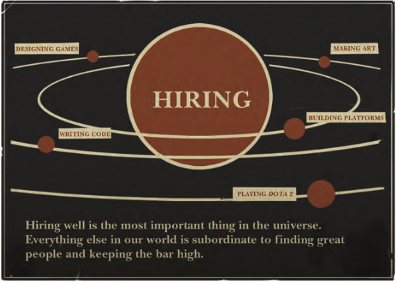
"Hiring well is the most important thing in the universe. Everything else in our world is subordinate to finding great people and keeping the bar high."
The Philosophy
The best companies made their hiring philosophy PUBLIC. They share how they hire, what they expect, and their entire culture. This attracts great people.
On "Vibe Hiring" (Cristina Cordova, ex-Stripe):
"What I've learned after doing a lot of hiring is that vibes do matter because hiring is fundamentally about making work easier, not harder."
"Vibes are signal, not a shortcut. They belong alongside structured evaluation, not instead of it."
The Counterintuitive Insight
| Traditional Approach | The Better Approach |
|---|---|
| Interview = assessment | Interview = sell the vision |
| Grill the candidate | Learn what excites them |
| Test their skills in conversation | Test their skills in discovery project |
| Candidate proves themselves | Both sides explore fit |
The Insight Most Companies Miss
Great candidates message the person they're interviewing with 15 mins before to say they'll be on the call. WHY CAN'T COMPANIES DO THIS FOR CANDIDATES?
Flip the script. Treat candidates like customers.
The 7 Mindsets That Separate Great Recruiters from Average Ones
Internalize these before doing any outreach. These are the beliefs and mental models that compound over time.
1. People Want Better Opportunities
They are interested to hear about yours because you will change their life with a few conversations.
What this means: You're not bothering people. You're offering them something potentially life-changing. Approach with confidence, not apology.
2. Sell to Both Sides
People want to talk to you if you present the opportunity in a way that sells to their emotional AND logical side.
| Logical | Emotional |
|---|---|
| Compensation, equity, title | Mission, impact, who they'll work with |
| Growth trajectory, skills gained | Status, recognition, belonging |
| Company metrics, funding | The feeling of doing meaningful work |
3. Expect "Not Interested"
Hiring is low probability, high magnitude work.
Expect and plan for NOT INTERESTED because timing is a crucial component to hiring. Someone perfect today might not be ready. Someone who says no now might say yes in 6 months.
4. Reach Out to the Impossible
The people you think are impossible to get are not impossible. Everyone is available. That is the mindset going into any conversation.
5. Let the Process Educate You
You're making bets about unknown unknowns. Most people don't have clarity on what they want, but they will after talking to you, and you'll gain clarity too.
Hiring is iterative. Improve your predictions on what makes great people want to work with you based on what they say, the patterns in conversations, and the things left unsaid.
6. Recruiting is Transference of Belief
Recruiting is a transference of belief over a bridge of trust. You must have 100/100 conviction that your company is an incredible opportunity for anyone on the planet.
7. Speed Up the Slowest Parts
An elite recruiter is able to speed up the slowest parts of the process vs speeding up what's already working. In most cases, the slowest parts are THEM and their team. Sourcing and writing.
What This Looks Like in Practice
| Average Recruiter | Great Recruiter |
|---|---|
| Apologizes for reaching out | Confident they're offering value |
| Pitches only the role | Pitches the emotional + logical |
| Gives up after one "no" | Builds relationships for the long game |
| Only reaches out to "realistic" candidates | Messages impossible people |
| Sticks to the script | Learns from every conversation |
| Goes through the motions | Has 100/100 conviction |
| Focuses on what's working | Fixes what's slow |
| Transactional calls | Leaves people happier |
The Compound Effect
These mindsets compound over time:
| Timeline | What Happens |
|---|---|
| Month 1 | You're learning, making mistakes, building conviction |
| Month 3 | Your pitch is sharp, you know the ponds, rejection doesn't faze you |
| Month 6 | Candidates come to you, referrals flow in, the impossible people respond |
| Year 1+ | You're known in the communities, your network IS the pond |
Prep Your Team Before Any Call
The Insight: When you prep your team with who this person is, your team shines on the call. Send this 1 hour before.
The Prep Template
[Interviewer Name], prep notes for your call with [Candidate Name].

BLURB ON [CANDIDATE NAME]:
[One sentence on what they do, using THEIR language]
[Something extraordinary about them to bring up in first 100 seconds]

STARTING FRAME:
[Why are you two talking? What's the point? What's the desired outcome?]

STRUCTURE FOR CALL:
• Intro: How we got on this call
• Pitch [Company], team, and vision if we can land this role
• Ask [Candidate] about their goals (optimizing for, what they work on)
• Discuss who the ideal person is for this role
• Ask: What would make this incredibly compelling for you?
• End call

IDEAL OUTCOME:
• [Candidate] wants to work with [Company] at all costs
• They understand the work and want to do a discovery project

ALTERNATIVE OUTCOMES:
• They introduce us to someone great in their network
• They start as a consultant to test fit
Key Principles
Line 1 - Use THEIR language:
| Wrong | Right |
|---|---|
| "He's a machine learning engineer" | "He builds AI chatbots with custom data. Calls himself an AI engineer who loves productivity." |
Line 2 - Something extraordinary: One thing the interviewer can bring up in the first 100 seconds as a pattern interrupt.
The Main Question:
"What would make this incredibly compelling for you?"
Their answer tells you exactly how to close them (or if you can't).
The Recruitment Sales Deck
Nobody does this. Companies interview candidates cold. No warm-up. No context. No excitement.
The Asset Stack (Send Every 48 Hours After Initial Interview)
| Asset Type | What It Is | Purpose |
|---|---|---|
| 1. The "Power" Write-Up | One great piece showing the power of what you do | Create desire |
| 2. Pitch Deck for Candidates | What VCs see, but for candidates | Share the vision |
| 3. CHECK IN | Just say hello, no ask | Build relationship |
| 4. CEO Content | Videos/podcasts from founder | Build trust |
| 5. Deep Dive Content | Educational content about the space | Position as experts |
Two Delivery Options
| Option | When to Use |
|---|---|
| All at once | Candidates already warm, moving fast |
| Drip (recommended) | Passive candidates, longer processes, high-value targets. Automate every 48 hours. |
Why This Works
| Benefit | Impact |
|---|---|
| They feel valued | Not just another applicant |
| Learning without repetition | Company info delivered automatically |
| Pre-sold by CEO call | By leadership conversation, they're already bought in |
The Candidate-Side Process Flow
CANDIDATE APPLIES
    ↓
Auto-confirmation email (immediately)
    ↓
Recruiter reviews (within 24hrs)
    ↓
Schedule call OR send discovery project (depending on seniority)
    ↓
PRE-CALL: Message candidate 15 mins before ("Looking forward to chatting!")
    ↓
CALL: Sell the vision, gather intel, assess fit
    ↓
POST-CALL: Send thank you + notes within 2 hours
    ↓
NURTURE: Assets every 48 hours
    ↓
DISCOVERY PROJECT: Personalized, with clear next steps
    ↓
REVIEW CALL: Walk through project together
    ↓
LEADERSHIP CALLS: CEO/founders only for key candidates
    ↓
OFFER or BENCH (with follow-up protocol)
Key Principle
At every stage, the candidate should know exactly what's next, feel like a priority, and have all the context they need.
When to Skip Yourself
If the candidate is clearly great (high signal from portfolio/background), skip the recruiter screen. Go straight to hiring manager or CEO. Become the "experience orchestrator" instead of interviewer.
Your role shifts: ensure candidate experience is smooth, prep each person in the interview process, and follow up with candidate after each interview.
Share Your Notes with the Candidate
The Insight: Context and deep cuts from conversations are lost 30 minutes later. Send candidates what you heard so they can adjust it. You want to represent their experience and motivations to the team as accurately as possible. This makes the whole process collaborative and unique.
Why Do This
| Benefit | How |
|---|---|
| Better candidate experience | They feel heard and valued |
| Cleaner handoff | Next interviewer gets context |
| Notes bank | You have detailed records for future |
| Follow-up ammo | Natural reason to reconnect later |
| Catch mistakes | They can correct anything you got wrong |
The Template
Hey [Candidate],

Thanks for the call today!

I'll share the following with our team (your background):

• [Key point about their background]
• [What stood out about their experience]
• [Their current situation/goals]
• [Relevant skills or achievements]
• [What they're looking for]

Did I miss anything, [Candidate]?

[Link to company resource 1]
[Link to company resource 2]

Last thing. [Answer any question they asked during the call]

Talk soon,
[Your Name]
When to Send
Immediately after the call. While notes are fresh. Within 1-2 hours max, before end of day at latest.
What to Include vs. What NOT to Include
| Include | Do NOT Include |
|---|---|
| Their background (career path, key experiences) | Your assessment of whether they're a fit |
| What they're optimizing for right now | Anything they said in confidence |
| Their strengths relevant to the role | Salary expectations |
| Any concerns or questions they raised | Comparisons to other candidates |
| Links to company resources they should review | Internal team opinions |
For Bench Candidates
When someone doesn't fit the current role but is great:
| Step | What to Do |
|---|---|
| 1 | Still send the follow-up notes |
| 2 | Be honest about fit: "This specific role may not be the best fit, but..." |
| 3 | Explore other options: "Based on what you shared, I'm wondering if X might be interesting" |
| 4 | Add to bench with context (your notes become gold later) |
If They Don't Advance
Still send the notes. Change the framing:
Hey [Candidate],

Thanks again for the call! Here are my notes from our conversation:

[Notes]

This specific role isn't the right fit, but I genuinely want to help
you find the best seat. I know a lot of people in the space.

How can I best serve your job search? Happy to make intros or keep
an eye out for roles that match what you're looking for.

In the meantime, take some time to go through Tanay's and Sahaj's
connections on LinkedIn and Twitter. If there's someone you'd like
me to intro you to, I'll do my best. Just let me know.

- Tanay: [LinkedIn] [Twitter]
- Sahaj: [LinkedIn] [Twitter]

Talk soon,
[Your Name]
Email Automation Sequences
Note: Works for any ATS including Ashby (which Wispr Flow uses). The key is automating touchpoints while keeping the human feel.
Email Flow Overview
| Stage | Senior Level+ | Mid Level & Below |
|---|---|---|
| After Apply | Auto-confirm (same) | Auto-confirm (same) |
| 24h Later | Schedule call email | Discovery project email |
| After Screen | Discovery project | (already did project) |
| Rejection | Personalized rejection | Personalized rejection |
EMAIL 1: Auto-Confirmation (All Roles)
Status: Automated Timing: Immediately after application submission
Subject: We received your application!

Hey [First Name],

Thank you! We have received your application to join [Company].

We will be reviewing your answers in detail... then I'll be in touch
with next steps.

In the meantime, check out this video on YouTube from our CEO, [CEO Name].

[1-2 sentence company mission/social proof]

I hope you're as excited about it all as we are. It's definitely
going to be a fun ride. :)

Stay tuned for an email from me as soon as we review your application.

Talk soon,
[Recruiter Name]
EMAIL 2: Senior Level (Schedule Call)
Status: Manual Timing: 24 hours later (after recruiter reviews)
Subject: Re: We received your application!

Hey [First Name],

Thank you again for applying to become our new [Role Title] at [Company].

We're excited to bring on a seasoned leader that will join our mission
of [company mission].

Now we need an incredible [Role Title] to help us [main responsibility] :)

I'd love to chat with you further. What does your availability look
like for a 30 minute call this week?

Please use the link below to schedule a time to chat:
[Calendly Link]

Talk soon,
[Recruiter Name]

---

PS - What you can expect moving forward (how we interview):

1. Intro Call with [Recruiter Name]
2. Discovery project to assess skill (2-4 hour take-home)
3. Leadership call #1
4. Leadership call #2
5. Final call with CEO

This will be a likely fit if:
• [Fit criteria 1]
• [Fit criteria 2]
• [Fit criteria 3]

This won't be a likely fit if:
• [Anti-fit criteria 1]
• [Anti-fit criteria 2]
• [Anti-fit criteria 3]

Still with me? If you read the above & think this is a likely fit
as your next career step, please schedule the call!
EMAIL 3: After Screening Call (Send Discovery Project)
Status: Manual Timing: 1 hour after screening call
Subject: Re: We received your application!

Hey [First Name],

Thank you again for applying & dedicating your precious time to [Company].

Our mission is to [company mission].

As discussed on our call (which I thoroughly enjoyed), we'd love to see
your genius in action with a short Discovery Project that's designed
to mimic the type of work you'll do at [Company].

Discovery Project Next Step:
• Click on the link to the [Role Title] Discovery Project
• Follow the steps in the page
• Once we receive your Discovery Project, we will review and select
  top candidates to move forward.

We are scaling and need an incredible [Role Title] like you to help us grow.

Talk soon,
[Recruiter Name]

---

What you can expect moving forward:

1. ~~Intro Call with [Recruiter]~~ (Complete)
2. Discovery project to assess skill **(YOU ARE HERE)**
3. Leadership call #1
4. Leadership call #2
5. Final call with CEO

Note: I am your personal concierge and will check in throughout your
entire process. Please let me know any questions, concerns, or feedback.
REJECTION: After Discovery Project
They spent hours on this. Reciprocate with your time.
Option 1: A call. Walk them through the decision live. Answer their questions.
Option 2: A 90-second Loom video.
| What to Cover | Example |
|---|---|
| Specific things that were great | "Your approach to X showed real depth" |
| High-level areas to improve | As they relate to the 3 non-negotiables for this role |
| Offer to help | How you can support their job search |
Two Examples From Past Automations
"This is one of the best email responses to an application I've seen - well done!"
- Actual candidate feedback on auto-confirmation email
"It was truly my pleasure to apply. This is by far the classiest and most uplifting rejection letter that I have ever received."
- Actual candidate feedback on rejection email
Key insight: Even rejected candidates become fans when treated with respect. They refer others and may reapply later.
Wispr Flow Application: ML Engineer Interview Prep
How to pitch the role credibly and handle objections from top ML engineers.
The Pitch (From Pillar 1 Scorecard)
This was built in the Role Definition phase. Use it in every interview:
| Why This Role is a Dream | |
|---|---|
| You own the full stack (on-device, not cloud) | No waiting on other teams |
| Clear success metric: zero edit rate | You know exactly when you've won |
| Sub-500ms latency is the bar | Real engineering constraints, not vanity benchmarks |
| Your improvements ship to millions of users | You'll feel the impact in days, not quarters |
| Work directly with founders | No layers of management between you and decisions |
Pitching the 6 Technical Challenges (L-A-C-P-P-L)
These challenges are what make Wispr different. Use them to excite candidates:
| Challenge | The Pitch |
|---|---|
| Latency Problem | "Every millisecond you shave, users FEEL it. Not some invisible backend optimization." |
| Accuracy vs Speed | "Can't brute force with GPUs. Have to be clever. Distillation, quantization, architecture." |
| Context Awareness | "Not dumb transcription. Building something that UNDERSTANDS. Real AI." |
| Personalization | "Learning from millions of users while respecting privacy. Real ML systems problem." |
| On-Device Privacy | "Privacy isn't a checkbox. It's a constraint that forces 10x better engineering." |
| Last Mile | "Anyone can build a demo. We're building something that works for everyone, everywhere." |
Depth Probes: The 8 Speech Recognition Challenges
Use these to test ML depth. The 8 accuracy challenges nest under "Accuracy vs Speed."
Source: wisprflow.ai/post/speech-recognition-challenges
| Challenge | Depth Probe Question |
|---|---|
| Short Audio Ambiguity | "How do you handle single-word utterances with no context?" |
| Background Noise | "What noise suppression techniques have you used?" |
| Accent Adaptation | "How have you trained for accent diversity?" |
| Domain Vocabulary | "How do you handle out-of-vocabulary terms like medical jargon?" |
| Code-Switching | "Any experience with multilingual or mixed-language input?" |
| Name Recognition | "How do you improve proper noun recognition?" |
| Incoherent Outputs | "How do you catch outputs that are logically wrong?" |
Green flags: They light up talking about these. They have war stories. They name specific techniques.
Red flags: They have never thought about these problems. Textbook answers with no real experience.
Handling Compensation Objections
When they say: "OpenAI offered $450K, what can you do?"
Response:
- Acknowledge: "You're right, we can't match OpenAI on base salary."
- Pivot to equity: "But we're Series A, not Series D. The equity window is still open."
- Ownership: "You also won't be engineer #847. You'll own real outcomes."
- Qualify: "If you're optimizing for cash, OpenAI might be right. If you want career-defining work and asymmetric upside, that's what we're offering."
Key rule: Never trash competition. Confidence > defensiveness.
Pitching to Skeptical Senior Engineers
When they say: "You're using Whisper like everyone else. What's different?"
Response:
- Acknowledge: "Yes, we build on Whisper. Great foundation."
- Explain the constraint: "But we run on-device. No cloud GPUs to fall back on."
- Frame the challenge: "At Google you solved with scale. Here you solve with engineering."
- Name hard problems: "Distillation on Apple Silicon. Quantization without accuracy loss. On-device personalization."
- Close: "The demo is easy. Making it work for everyone, everywhere, every time. That's the puzzle."
Qualifying Candidates
| Let Them Go Gracefully When | Fight For Them When |
|---|---|
| Purely optimizing for cash | Asking about hard technical problems |
| Want "pure research" role | Concerned about impact/ownership |
| Brilliant jerk signals | Pushing back on your answers |
| Eyes light up at constraints |
Red Flags in ML Engineer Interviews
| What They Say | Why It's a Red Flag |
|---|---|
| "I'd use a bigger model" | Doesn't understand on-device constraint |
| "Just ship to cloud" | Doesn't respect privacy constraint |
| "I just want to do research" | Early-stage = everyone ships |
| "10x more data would solve this" | Brute-forcer, not engineer |
Green Flags in ML Engineer Interviews
| What They Say | Why It's a Green Flag |
|---|---|
| "How do you handle the latency constraint?" | Understands the real problem |
| "What's your approach to on-device inference?" | Technical curiosity |
| "That's a really hard problem" | Gets excited by constraints |
| "I've done distillation/quantization before" | Relevant experience |
Things to NEVER Do
- Never make up technical specifics - Engineers will catch you
- Never trash competition - "OpenAI is a great company. Different stage, different tradeoffs."
- Never get defensive about constraints - Frame them as what makes it interesting
- Never oversell stability - "We're 15 people. It's fast, it's ambiguous, it's not for everyone."
Wispr Flow Application: ML Engineer Recruiter Pitch
This pitch was built using the Recruiter Pitch Template in Pillar 2. Create role-specific pitches for every role using that process.
Every Interviewer Gets Their Own Pitch
The recruiter pitch is just the first one. Run the same process from Pillar 2 for every person in the interview loop.
The goal: Dig into different things on every call, sell the candidate on every call, and have a game plan beforehand so it's structured, professional, and useful to the candidate.
| Interviewer | Their Pitch Focus |
|---|---|
| Recruiter | Sell the vision, qualify fit, answer "why Wispr" |
| Technical Lead | Dive into the problems, show the interesting challenges |
| CTO/Founder | Close the deal, paint the future, answer real concerns |
| Team Member | Day-to-day reality, culture proof, "what it's really like" |
THE RECRUITER CALL FLOW
The Purpose of This Call:
You're not making a hiring decision on this call. The whole point is to excite the person, represent Wispr Flow and the team in the best way possible, and move them towards the next part of the process. The candidate should want to continue to the next call. That's the goal of every session.
PHASE 1: OPEN
What You Say:
"Hey [Name]. Great to meet you. Before we get started, I just wanted to say I read through your application, and [specific thing that stood out]. I specifically liked that you said [the thing they said that relates back to Wispr Flow]."
"This call is going to be chill, low pressure. I just want to learn more about your background, share what we're doing here at Wispr Flow, and see if there's a fit."
"I also think about these calls in a different way. My job isn't to try to catch someone or assess their entire skill set in a 30 minute call, which is actually impossible. But I think that you're incredible, and that's why we're on the call in the first place."
"I use the frame: 'What's the best seat for this person?' Whether it's at Wispr Flow or somewhere we're connected to. That's what I'm obsessed with."
PHASE 1.5: LEARN WHAT THEY KNOW + FILL IN THE GAPS
What You Say:
"Before I get into the role, I'm curious. What do you already know about Wispr Flow? What have you seen online?"
Listen. This tells you what to skip and what to explain.
"Cool, let me fill in the gaps..."
The One-Liner:
"We're replacing the keyboard. Building voice interfaces so good that talking to your computer feels like talking to a friend."
The Problem:
"Here's the thing most people don't realize. People type at 40 words per minute. But they think at 400 words per minute. The keyboard, this thing we've used for 150 years, is a bottleneck to human potential."
"Voice interfaces have sucked for 30 years. Slow, inaccurate, awkward. Most 'AI voice' is cloud-dependent wrappers. Nobody's actually solved this."
The Solution:
"That's what we're doing at Wispr. We built Flow. It's the first voice dictation platform that people actually use MORE than their keyboards. On-device ML. Sub-500ms latency. Context-aware, so it knows if you're in Slack versus email. The goal is zero edit rate."
Social Proof:
"We've raised $81 million. Latest round was $25M led by Notable Capital and Steven Bartlett's Flight Fund. We're growing 50% month over month. Team of 15, scaling to 50."
5 Surprising Things (Deep Cuts):
| Fact | Why It's Surprising |
|---|---|
| They killed their own hardware to save the mission | Were building premium AirPods competitors. Killed it because software reaches billions faster |
| Tanay has been obsessed with J.A.R.V.I.S. since age 10 | Watched Iron Man in 2008, pulled his first all-nighter that night to learn to code |
| Zero Data Retention agreement with OpenAI | Even when using GPT-4o, OpenAI can't train on Wispr data |
| Built the only AI that fluently speaks Hinglish | The language of 1 billion people. OpenAI didn't bother. Wispr did |
| Internal build v90+ before the world saw v1 | They iterate 10x faster than Big Tech |
The Arc:
"Act 1 was dictation. We nailed it. Users literally hide Wispr from their coworkers because it's an unfair advantage."
"Act 2 is the action layer. Voice that doesn't just transcribe, it DOES. Schedule this meeting. Write this code. Search my emails."
"Act 3 is J.A.R.V.I.S. The AI companion Tanay dreamed about since he was 10."
PHASE 2: KNOCKOUT + DIVE DEEP
What You Say:
"So what we're looking for in this role... the key thing is someone who has shipped on-device speech recognition with sub-500ms latency to production users. What's your experience around that?"
PATH A: YES (Continue)
"I'd love to learn more. Can you explain how you did that step by step, in the simplest way possible? How would you explain it to someone like my mom who isn't in tech?"
PATH B: NO (Dive Deeper)
"Okay, based on my understanding, it sounds like you don't have on-device machine learning experience. But what you said you do have is [repeat back what they said]."
Then ask: "What's something you want to build next? Something that when you ship it, you'd say 'Wow, that's impressive.'"
PHASE 3: THE ROLE
What You Say:
"So the role. You'd be working directly with Sahaj, our CTO, and Tanay, the CEO. ML team is 3 people right now, scaling to 10. You'd help shape who we hire."
"The core problems you'd own:"
"One: the latency problem. Sub-500ms from speech to text on screen."
"Two: accuracy versus speed. Bigger model means more accurate but slower. You'd get clever with distillation, quantization, architecture."
"Three: personalization at scale. Models that adapt to each user over time."
"Four: the last mile. 99% to 99.9% is brutal. Edge cases. Rare accents, background noise, jargon, mumbling."
The Hook:
"If you do this well, in 18 months you'll be known as the person who made Flow fast. Your code will run every time someone talks to their computer."
PHASE 4: QUALIFICATION QUESTIONS
Graham Duncan Questions (Pick 2-3):
"If you were in my seat, what criteria would you use to hire someone for this role?"
"What are you compulsive about?"
"Let's imagine it's 6 months from now and it didn't work out. What's your best guess about what went wrong?"
PHASE 5: THEIR QUESTIONS
What You Say:
"What questions do you have for me?"
Common Questions:
| Question | Your Answer |
|---|---|
| "What's the tech stack?" | "Python, PyTorch, on-device inference. But the stack matters less than the problems" |
| "What's the team like?" | "15 people who chose this over Google, Meta, Anthropic offers" |
| "What's comp?" | "$130K-$240K base plus generous equity. We're early, the equity matters" |
PHASE 6: END ON A HIGH NOTE
For Strong Candidates:
"I really enjoyed this conversation. We move fast here. My role becomes more of your personal assistant throughout this process. Reach out directly to me with questions, and I'll respond as quickly as I can."
Map Out The Process:
| Step | What It Is |
|---|---|
| 1. This call | Recruiter screen (done) |
| 2. Technical deep dive | With Sahaj (CTO) |
| 3. Discovery project | Real problems |
| 4. Team day | Meet the people you'd work with |
| 5. Offer | Fast decisions, transparent comp |
The Notes Email:
"After this call, I'll send you my notes. If I misunderstood anything about your background, let me know before I share with the team."
For Candidates Who Aren't A Fit:
"I really appreciate your time. Based on what we're looking for right now, I don't think this specific role is the right fit. But is there any way I can help in your search?"
"If you go through Tanay's connections or Sahaj's connections on LinkedIn and see someone you'd love to speak to, I'll try my best to make the introduction."
KNOW THESE NUMBERS COLD
| Metric | Value |
|---|---|
| Total funding | $81M |
| Latest round | $25M (Notable Capital + Steven Bartlett's Flight Fund) |
| MoM growth | 50% revenue |
| Current team | 15 people |
| Scaling to | 50 people |
| Comp range | $130K-$240K + generous equity |
| Latency target | Sub-500ms |
| Accuracy target | Zero edit rate |
Wispr Flow Application: ML Engineer Reference Checks
Get signal beyond "they're great." These questions reveal what really matters for an early-stage ML role.
The 6 Questions That Actually Work
1. Calibration (Universal)
Ask: "On a scale of 1-10, how would you rate [Candidate]? And what would make them a 10?"
Why it works: Forces specificity. The gap between their rating and 10 reveals weaknesses. If they say "10/10" immediately, probe: "Really? No areas for growth?"
| Listen For | What It Means |
|---|---|
| Hesitation | Something they're not saying |
| "8... well, maybe 7" | They're being honest |
| Specific examples vs. vague praise | Depth of knowledge about candidate |
2. Handling Disagreement (ML-Specific)
Ask: "When [Candidate] disagreed with a technical decision, like model choice or architecture, how did they handle it?"
| Listen For | What It Means |
|---|---|
| "They made their case, then committed fully" | Green flag |
| "They kept bringing it up after we decided" | Red flag |
| "They never really pushed back" | May lack conviction |
3. Speed vs Quality (Startup-Specific)
Ask: "How did [Candidate] balance shipping fast vs getting it right?"
| Listen For | What It Means |
|---|---|
| Stories of shipping imperfect things that worked | Pragmatic |
| Stories of knowing WHEN to slow down | Good judgment |
| "They shipped fast but it was always solid" | Rare and valuable |
4. Ownership (Leadership Signal)
Ask: "Tell me about a time [Candidate] took ownership outside their job description."
| Listen For | What It Means |
|---|---|
| "They noticed X was broken and fixed it" | High agency |
| "They always did exactly their job" | May struggle with ambiguity |
| Specific examples of going beyond | Ownership mindset |
5. Under Pressure (Founder-Fit)
Ask: "How did [Candidate] perform when a deadline was at risk? Or when something broke in production?"
| Listen For | What It Means |
|---|---|
| "They got calm and focused" | Ideal |
| "They worked all weekend" | Dedication, but check for sustainability |
| "They blamed others" | Major red flag |
6. THE KILLER QUESTION
Ask: "If you were starting a company tomorrow, would you hire [Candidate]? For what role?"
| Listen For | What It Means |
|---|---|
| "Absolutely, for [specific role]" | Strong signal |
| Hesitation | Something's off |
| "As a contractor maybe, not full-time" | They have reservations |
| "Not for a founding role" | May need more structure than we can offer |
Red Flags in References
| What They Say | What It Means |
|---|---|
| Hesitation on the killer question | They have reservations they won't say directly |
| "Needs structure" | Bad for early-stage chaos |
| "Great individual contributor" | May not collaborate well |
| Praising only technical skills | Nothing about teamwork or communication |
| "I'd hire them as a contractor" | Not full-time material in their view |
Green Flags in References
| What They Say | What It Means |
|---|---|
| Specific stories about shipping despite constraints | Relevant experience |
| "They taught others on the team" | Leadership potential |
| "I'd hire them for a leadership role" | High ceiling |
| "They made everyone around them better" | Force multiplier |
| "When things broke, they were the calm one" | Handles pressure |
| "They pushed back on my ideas, and they were right" | Has conviction |
ML-Specific Follow-Ups
On Production ML:
Ask: "Did they ship models to production, or mostly work in notebooks?"
| Listen For | What It Means |
|---|---|
| "They owned the full pipeline" | Strong |
| "They handed off to engineering" | Concerning for our role |
On Constraints:
Ask: "Did they ever have to optimize under constraints, like latency or memory?"
| Listen For | What It Means |
|---|---|
| "They were creative about making it work" | Constraint-thinker |
| "They asked for more resources" | May not fit our on-device constraint |